Empowering Off-Grid Energy: Insights from the MicroPowerManager (MPM) Roadmap
June 5, 2026
Building a Community of Open Source Champions
July 17, 2026
A mission that hit close to home
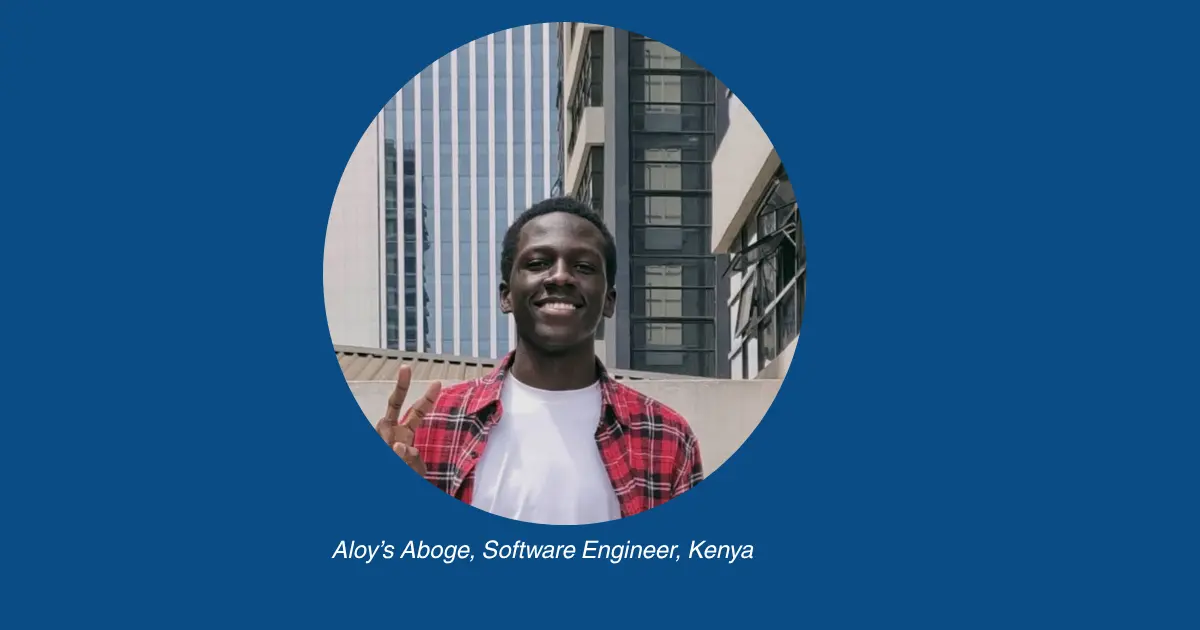
Aloys has spent the past four years building web and mobile applications, with a background in Computer Science and a long-standing fascination with technology. He discovered OSEA almost by accident.
“Last year, while looking through some projects on the Linux Foundation platform, I went down a bit of a rabbit hole and discovered the OSEA community. I also noticed that the community had held an event right here in Nairobi earlier that year, which I unfortunately missed, but it definitely sparked my interest to see such impactful work in Open Source happening locally.”
What turned that interest into action was MicroPowerManager itself. For Aloys, the energy access mission was not abstract.
“Growing up in Kenya, you see firsthand how vital reliable energy infrastructure is. I have literally seen Sun King installations operating back in my hometown, so when I came across MicroPowerManager, everything just clicked. Finding an Open Source project that works on problems you can actually see outside your window, and knowing the code you write can help scale those real-world solutions, made me want to dive right in.”
It helped that the project used a familiar and preferred technology stack. His first contribution, issue #1073, was a deliberate choice: a real problem affecting MPM users, and a good way to learn the codebase at the same time.
Building a Field App that speaks the right language
For v0.0.8, Aloys wired up device-locale detection, shipped five locales (English, French, Portuguese, Arabic, and Burmese), and built a Settings screen with a language picker so agents can switch without digging through menus. The work drew on his day job building apps for the Japanese market, but the impact, he explains, is anything but routine.
“Agents shouldn’t be mentally translating English while collecting a payment in front of a customer. This will improve the overall experience for both agents and the customers being onboarded.”
The Field App is used by people on the move, going from one customer’s home to the next, most of whom do not speak English as a first language. Localising the interface, Aloys points out, is about far more than convenience.
“They need to be able to glance at the screen and understand it instantly. Localising the app cuts down on simple mistakes, makes training new agents much faster, and saves them from those awkward moments of trying to explain a confusing user interface to a customer. And when an agent shows a customer a screen or a receipt in a language they actually speak, it builds immediate trust.”
The bug that almost slipped through
The trickiest part was not the languages themselves, but a quiet mismatch in how Burmese is identified. The MPM backend uses the code “bu” for Burmese, while the standard ISO code on most devices is “my”. Matching the device blindly would have broken the sync.
“The app would treat ‘bu’ as unknown and silently fall back to English, which would be an annoying bug to track down.”
Rather than paper over it, Aloys kept “bu” inside the app to match the backend and built a small mapping layer to translate “my” to “bu” for device lookups, then left a comment above the provider so the next developer would not have to work it out from scratch.
“It’s a tiny detail, but it shows why internationalisation is tricky.”
Along the way, he picked up new ground too: mounting the i18next provider correctly inside Expo Router (below the session provider, so the translation engine can read server settings for its fallback language) and using expo-localisation to read device locales cleanly on both iOS and Android. “Also, if it counts,” he adds, “I learned a little French.”
A welcoming community
Advice for first-time contributors
Asked about working with OSEA and the MPM maintainers, Aloys is unequivocal.
“It has been great, honestly. A very welcoming community. The maintainers have always given useful feedback and pointers whenever I showed interest in handling an issue or submitting a solution.”
He wanted to give a particular shout-out to maintainers Obinna Ikeh and Daniel Mohns, who, in his words, “made the process very smooth since day one.” He also appreciated a small but telling detail: that issues come with proposed solutions and approaches, which help get the conversation started.
For anyone weighing up their first Open Source contribution, Aloys has clear, encouraging advice:
“Don’t be intimidated by the size of a codebase. You don’t need to understand every single line of code to make a meaningful impact. Start small, whether it’s fixing a typo, writing a test, or tackling a ‘good first issue.’ And don’t hesitate to ask questions in the community channels. Most Open Source communities will be happy to welcome you and help you get started.”
What’s next
Aloys is already looking ahead, and his plans are rooted in the place he calls home.
“Within MicroPowerManager, I’m really keen to help build out Kenya-specific features and plugins, particularly localised payment integrations like M-Pesa. Being based in Kenya, I use these systems daily, so I am well-positioned to test the integrations and make sure they work seamlessly for local agents and consumers.”
More broadly, he wants to keep contributing to projects that empower local communities, which is exactly the spirit in which OSEA was built.
Aloys’s story is a reminder that the most valuable contributions often come from people who can see the problem from where they stand. From a rabbit-hole discovery on the Linux Foundation platform to shipping local languages to field agents, his journey shows what Open Source in Energy Access is all about.
Thank you, Aloys, for your work on MicroPowerManager, and for sharing your story with us.